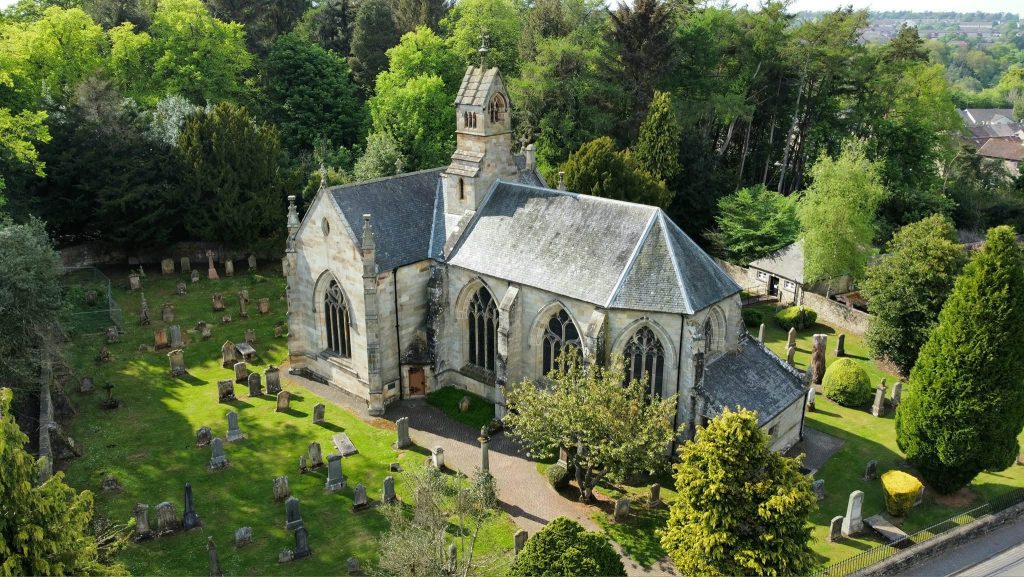
Kirk of Calder is a 16th century church dating from 1541 built on the site of an earlier 12thcentury church and with an extension added in the 1860s. Our church has close links with theReformation of 1560 that swept aside centuries of Catholic tradition. The Reformation’sProtestant leader, John Knox, preached in our church and its grounds whilst staying at nearbyCalder House at the invitation of the Laird, Sir James Sandilands, between 1555 and 1556.Whilst there, Knox celebrated the first Holy Communion after the reformed rite. Also, one of ourministers, John Spottiswoode the elder, helped draft the Scots Confession of 1560, a confessionof faith guided by Knox. Musket-ball holes can be seen in the stonework outside the church’smain door that reflect the struggles of the Covenanters, a significant group within the Reformation.
The spring of 1643, saw the ordination of Hew Kennedie at Kirk of Calder and his zealousmission to eradicate witchcraft from the Calder parish. At least five women weretortured andthen executed under his watch. Thanks to the volunteer-led Calder Witch Hunt project, toexplore and commemorate these innocent women, our church holds exhibits that include theoriginal stool of repentance that the women were made to standon as well as replica clothingand details of the trials and tribulations endured by the women. In August 2023 a memorialstone was placed in our vestry, where the women had been imprisoned and tortured, and it isbelieved that its setting within a Churchof Scotland building makes it unique. Our vestry alsohouses one of two Celtic crosses from the original 12th century church; the National Museumof Scotland holds the other.
James‘Paraffin’Young and his family were regular worshippers at Kirk of Calder. One of the greatinnovators and chemists of his age, Young was a pioneer of the oil industry whose daughterdonated two fine stained-glass windows. One is in memory of her parents and the other of herdaughter Mary who died aged 12 and is buriedin our church grounds. It is believed that theexplorer David Livingstone, a close friend of Young, would also have visited our church duringhis stays with Young at Limefield House, Polbeth. Similarly, it is also felt that Polish composerand virtuosopianist, Frederick Chopin, may have visited Kirk of Calder given his stay at CalderHouse with Lord and Lady Torphichen in 1848 initiated by Jane Stirling, sister of the 10th LadyTorphichen and pupil of Chopin. Such was her devotion that upon his death she became knownas‘Chopin’s Widow’.
Peter McLagan MP is buried at Kirk of Calder and his wife and step-daughter commemoratedthere. A graduate of Edinburgh University, and of humble origins, he was the first to exploit shaleto produce oil rather thanthe cannel coal used by Young. However, and through his highstanding in society, he eventually became an MP. When he left Parliament in 1893 he was thelongest serving Scottish MP on record having served 28 years as MP for Linlithgowshire. Until2019,it had been completely forgotten that McLagan, born in Demerara, was of mixed racemaking him the first mixed-race MP in Scotland. His commitment, decency, kindness andability were all that mattered to the many that attended his funeral, one of the largest within ourparish.