Also prepared a pamplet on the Witch Hunts and he would often give talks to local organisations on the subject!
This main basis of this article is the pamphlet by our former minister Rev John M Povey, MA BD which is available in our publications section.
It covers initially the background to the pursuit of Witches in Scotland, and then more particularly in the Parish of Calder.
Although long after not a Witch – There is also a postscript on Lizzie Brice (Bryce)
Witchcraft in Scotland
Refurbished in 1995, the Stained glass windows are considered to be of very fine quality, not often seen in provincial churches of this kind. Despite being of similar profiles, all the windows all have different stone mullion patterns
The older part of the building constructed in 1541 has two stained glass windows. The oldest is the East window (above the present balcony) which according to the Kirk session minutes of 1864 indicates that a window designed by Messrs, Field and Allen, Frederick street, Edinburgh had been inserted as a replacement for an earlier window. It depicts the four evangelists: Matthew, Mark, Luke and John.
An interesting footnote for those who think that trials for witchcraft were confined to our superstitious ancestors long ago; In 1944, Helen Duncan (1898-1956), a Scottish medium, was the last person to be jailed under the 1735 Witchcraft Act. A court was told she claimed to have conjured up the spirit of a sailor killed on HMS Barham during World War II. The sinking of this ship was supposed to be a military secret and the British authorities decided to prosecute because they reportedly feared that Helen Duncan might reveal plans for the D- Day landings. She was convicted of “pretending to raise spirits from the dead” and sentenced to 9 months in prison. The 1735 Witchcraft Act was only finally repealed in 1951.
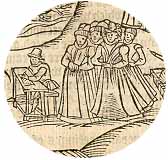
The “Calder Witches” were said at the time to be as proverbial as the Lancashire witches in England. Cunnigar hill in the village was known as “Witches Knowe” and was the spot where witches were put to death.
| 1591 | John Spottiswoode (Minister from 1585-1604) was enthusiastic in the persecution of witches and wrote in 1591 “Much of the winter as been spent in the discovery and examination of witches and sorcerers” |
| 1644 | Hew Kennedie (Minister from 1643-1660) began his career in Mid Calder with a zealous crusade against witches. We have records of four incidents that year. |
| 1644 | Agnes Bischope who was detained in the tollbooth in Linlithgow, was brought back to Calder and after due “trial and examination” confessed to be a “common charmer and heinous and notorious witch” and was condemned to be executed according to the law” |
| 1644 | The records show that a David Aikman paid the Kirk Session 100 merks to defray expenses incurred in the trial, imprisonment and execution of his wife. |
| 1644 | The Kirk Session minutes of September relate that “being the Sabbath day, Jeanne Andersoune made publict satisfaction in sackcloth for charming, and the minister made certifactioun to her if ever should be tryed to use charming hereafter she should be held to be a witch” |
| 1644 | And one that got off ! – The register of the Privy Council in December states ” Complaint by Margaret Thomson in Calder against the Tutor and minister of that parish for ‘waking her the space of twenty days naked and having nothing on her but a sackloth’ under a charge of witchcraft. Also that she had laid in the stocks and kept separate from all company and worldly comfort, nor could she see any end to her misery by lawfull trial’. The Lords having the minister and tutor before them and no regular charge being forthcoming, ordained her to be liberated” |
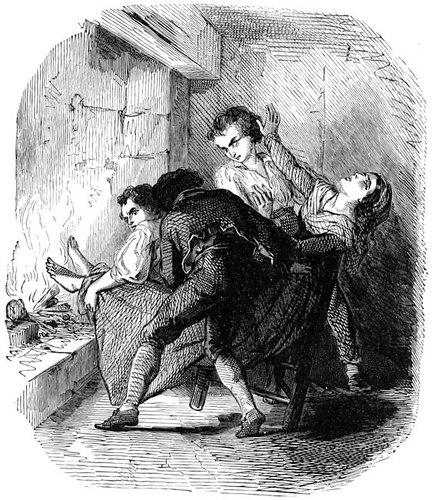
| 1720 | The Strange Case of 1720 – The best known case of witchcraft in Mid Calder came strangely as late as 1720. The Hon Patrick Sandilands, third son of James, 7th Lord Torphichen , and then a boy of twelve years was said to be bewitched. Declaring that some old women and a man in Calder had bewitched him, he fell down in trances “from which no horse-whipping could rouse him till he chose his own time to revive” pronounced prophecies, and was said to be the subject of of other strange phenomena as such as being lifted in the air by “invisible hands” |
To find Cunnigar Hill if starting at the Church – it is an approx 5 minute walk. Travel North on Main St (towards the village) passing our church hall (the Glenalmond Hall) on the left. With the “Black Bull Pub” in front of you, turn right then immediately left into Bank St (noticing on the right “The McPovey” – a metal Highland Cow placed in honour of our previous minister), keeping hairdresser ‘“Just -a-Head” on your right travel 25 metres down the lane and turn immediately left, carry on to “Abbey J Cakes” on the left and go down the path into the park and after 30 metres Cunnigar Hill will be revealed s on your left!